
Recommendation Engine Development for Retail to Increase Conversions and Personalized Shopping Experiences
Modern consumers expect personalized shopping experiences. Whether browsing an ecommerce website, using a mobile app, or shopping on a marketplace, customers are more likely to engage with products that match their interests and behavior.
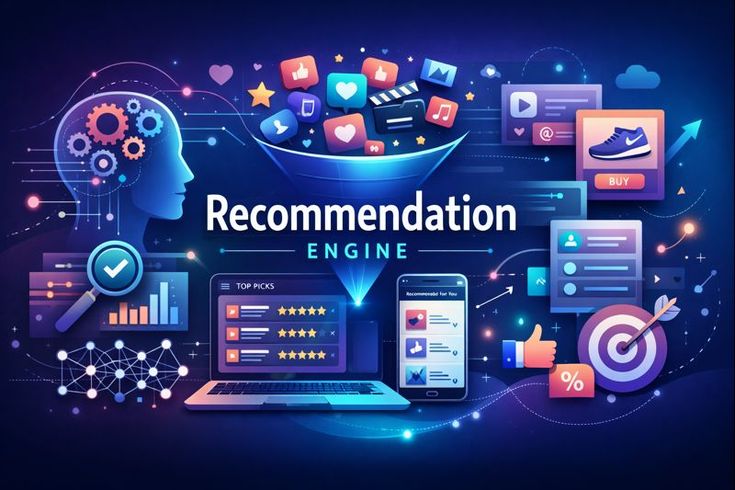
A recommendation engine enables retailers to analyze customer behavior, identify patterns, and deliver intelligent product recommendations in real time.
We develop AI-powered recommendation engines for retailers, ecommerce businesses, and marketplaces across the US, UK, and global markets—designed to improve conversions, increase average order value, and enhance customer engagement.
Why Personalization Matters in Modern Retail
Retail has shifted from mass selling to personalized customer experiences.
Common challenges include:

Today’s customers expect:
Personalized offers
Faster product discovery
Tailored shopping experiences

Businesses that fail to personalize experiences often face:
Reduced engagement
Higher cart abandonment
What Is a Recommendation Engine?
A recommendation engine is an AI-driven system that analyzes user behavior and product data to suggest relevant products or content.
It helps customers discover products they are more likely to purchase.
Core capabilities:
Personalized product recommendations
Behavioral analysis

Real-time suggestion generation

Customer segmentation
How Recommendation Engines Work
Recommendation systems process large volumes of data to identify patterns and preferences.
Typical data sources include:
Purchase history
Search behavior
Product interactions
Customer demographics
Workflow:
2. Analyze patterns using AI algorithms
3. Generate product recommendations
4. Display recommendations in real time
Types of Recommendation Engines
Different recommendation models serve different business needs.
Collaborative Filtering
“Customers who bought this also bought…”
Content-Based Filtering
Hybrid Recommendation Systems
Improves accuracy and personalization
Key Features of a Modern Recommendation Engine
Personalized Product Recommendations
Dynamic recommendations based on behavior
Real-Time Recommendation Processing
Adapt to live user activity
AI and Machine Learning Integration
Learn from customer interactions
Cross-Sell and Upsell Optimization
Increase average order value (AOV)
Recommendation Engines and Conversion Optimization
Recommendation systems directly impact ecommerce revenue.
Key business benefits:
Higher average order value
Improved customer retention
Longer browsing sessions
Example
– Phone cases
– Chargers
– Wireless earbuds
Results
Real Use Case: AI Recommendation System for Ecommerce
We worked with an ecommerce retailer struggling with low product discovery and engagement.
Challenges:
Low conversion rates
Limited personalization
Solution
Implemented real-time behavioral analysis
Personalized homepage and product page recommendations
Results
Higher average order value
Improved customer engagement
Recommendation Placement Across Customer Journey
Recommendations should appear at strategic touchpoints.
Common recommendation placements:
Product detail pages
Shopping cart recommendations
Checkout upselling
Email marketing recommendations
Benefits:
Better product discovery
Higher sales opportunities
Integration with Retail Ecosystem
Recommendation engines work best when integrated with retail systems.
Common integrations:
CRM Systems
Omnichannel Platforms
Benefits:
Better personalization
Cross-channel recommendations
AI and Machine Learning in Recommendation Engines
Modern recommendation systems rely heavily on AI technologies.
Common AI techniques:
Predictive analytics
Behavioral modeling
Deep learning
Benefits:
Continuous optimization
Better customer insights
Cost to Build a Recommendation Engine
Starting from $12/hour, depending on developer experience and project complexity.
Recommendation Engines for US, UK, and Global Markets
We build scalable recommendation systems for global ecommerce businesses. Key global considerations:
Multi-language support
Multi-region customer behavior
Localization
Scalability for high traffic
System Architecture for Recommendation Engines
A scalable recommendation engine requires robust infrastructure.
Core components:
AI/ML processing engine
Recommendation API
Analytics dashboard
Benefits:
High performance
Scalability
Data Privacy and Security
Recommendation systems process customer behavior data. Key considerations:
GDPR compliance
Data encryption
User privacy controls
Secure data storage
Offshore Development Advantage
Many retailers choose offshore teams for AI and recommendation system development. Benefits:
Lower development cost
Access to AI expertise
Faster implementation
Flexible team scaling
Custom Recommendation Engine vs Third-Party Plugins
Limitations of generic recommendation plugins:
Generic algorithms
Restricted scalability
Benefits of custom recommendation engines:
Better performance
Full control over customer data
Who Needs Recommendation Engines?
Ecommerce businesses
Online marketplaces
Retail brands
Subscription commerce platforms
Frequently Asked Questions
What is a recommendation engine?
An AI-powered system that suggests products based on customer behavior and preferences.
Can recommendation engines improve sales?
Yes, personalized recommendations significantly improve conversions and average order value.
Is AI required for recommendation systems?
Modern systems typically use AI and machine learning for better accuracy.
Can it integrate with existing ecommerce platforms?
Yes, recommendation systems integrate with ecommerce and CRM platforms.
Build an AI-Powered Personalized Retail Experience
A recommendation engine helps retailers improve customer experience, increase conversions, and maximize revenue through intelligent personalization.
Build a scalable AI-driven recommendation system tailored to your retail business and customer journey.